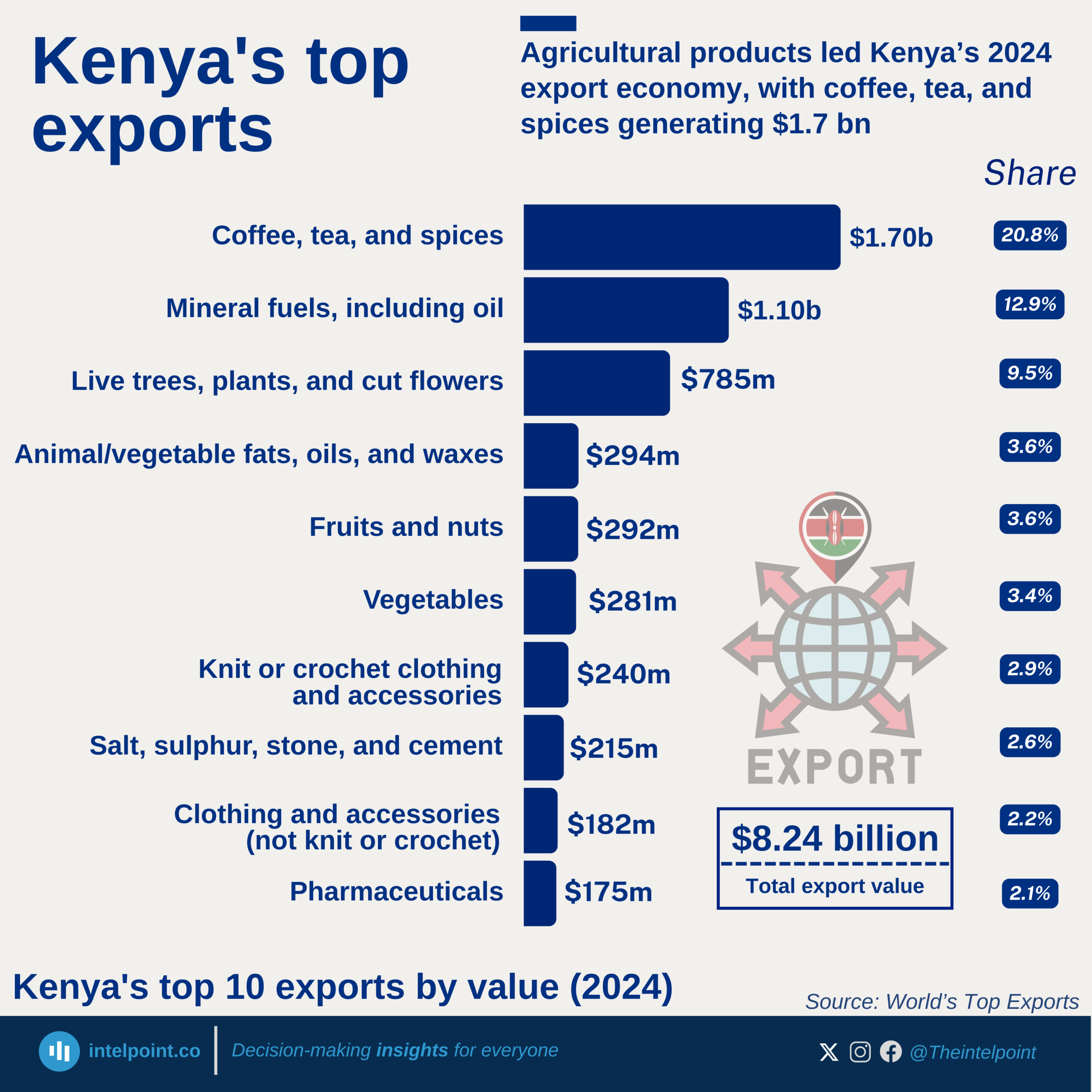
Agricultural products led Kenya’s 2024 export economy, with coffee, tea, and spices generating $1.7 bn

  • Agriculture dominated Kenya’s exports, with coffee, tea, and spices alone contributing $1.7 billion, the largest single export category.
  • Mineral fuels were a surprisingly strong second, delivering $1.1 billion, and showing Kenya’s growing role in regional fuel distribution.
  • Horticultural exports (flowers, live plants, and trees) contributed $790 million, reinforcing Kenya’s global strength in floriculture.
  • All other export categories fall below $300 million individually, reflecting a long list of small but diverse export segments such as textiles, vegetables, and pharmaceuticals.

Kenya’s 2024 export economy was anchored in agriculture, with coffee, tea, and spices accounting for $1.7 billion, making them the country’s top exports by a clear margin.

This leadership reflected Kenya’s long-standing dominance in global tea markets and its rising output of high-value coffees and spices. Interestingly, mineral fuels followed closely at $1.1 billion, signalling Kenya’s expanding role as a refined-fuel hub in East Africa despite not being a major crude producer.

The rest of Kenya’s export landscape showed strong diversification across horticulture, food crops, and manufactured goods. Live plants, cut flowers, and tree products brought in $790 million, underscoring Kenya’s globally competitive floriculture industry.

Meanwhile, smaller but notable categories, including textiles, pharmaceuticals, vegetables, and nuts, contributed between $180 million and $290 million each.
Source:

World's Top Exports

Period:

2024
HTML code to embed chart
Want a bespoke report?
Reach out
Tags
Related Insights

Nigeria's non-oil exports grew faster than oil exports in 2024 and 2025, though oil remained dominant
  • In 2025, non-oil export growth (36%) was 6x higher than oil (6%).
  • In 2024, non-oil exports grew by 189% vs oil’s 108%.
  • Total exports still heavily depend on oil.
  • Export value rose from ₦36 trillion in 2023 to ₦85.1 trillion in 2025.

Nigeria imported 10x more from Asia than from Africa in 2025
  • Asia is Nigeria’s top import source in 2025.
  • The highest import value from Asia was recorded in Q1 at ₦8.7 trillion.
  • Imports from Europe surged to ₦8.6 trillion in Q2 but declined to ₦6.6 trillion by Q4.
  • Imports from America showed continuous growth, rising from ₦2.9 trillion in Q1 to ₦6.6 trillion in Q4.
  • Imports from Africa remained below ₦1 trillion across most quarters.

China’s exports to Nigeria increased by 40% in 2025
  • China’s exports to Nigeria increased by 40.4%,
  • China's exports moved from ₦ 14.1 trillion in 2024 to ₦ 19.8 trillion in 2025.
  • Growth was consistent across all four quarters.
  • Quarter 2 saw the highest growth at 80%, jumping from ₦3.0tn to ₦5.4tn.
  • Quarter 4 recorded a modest 4.3% rise.

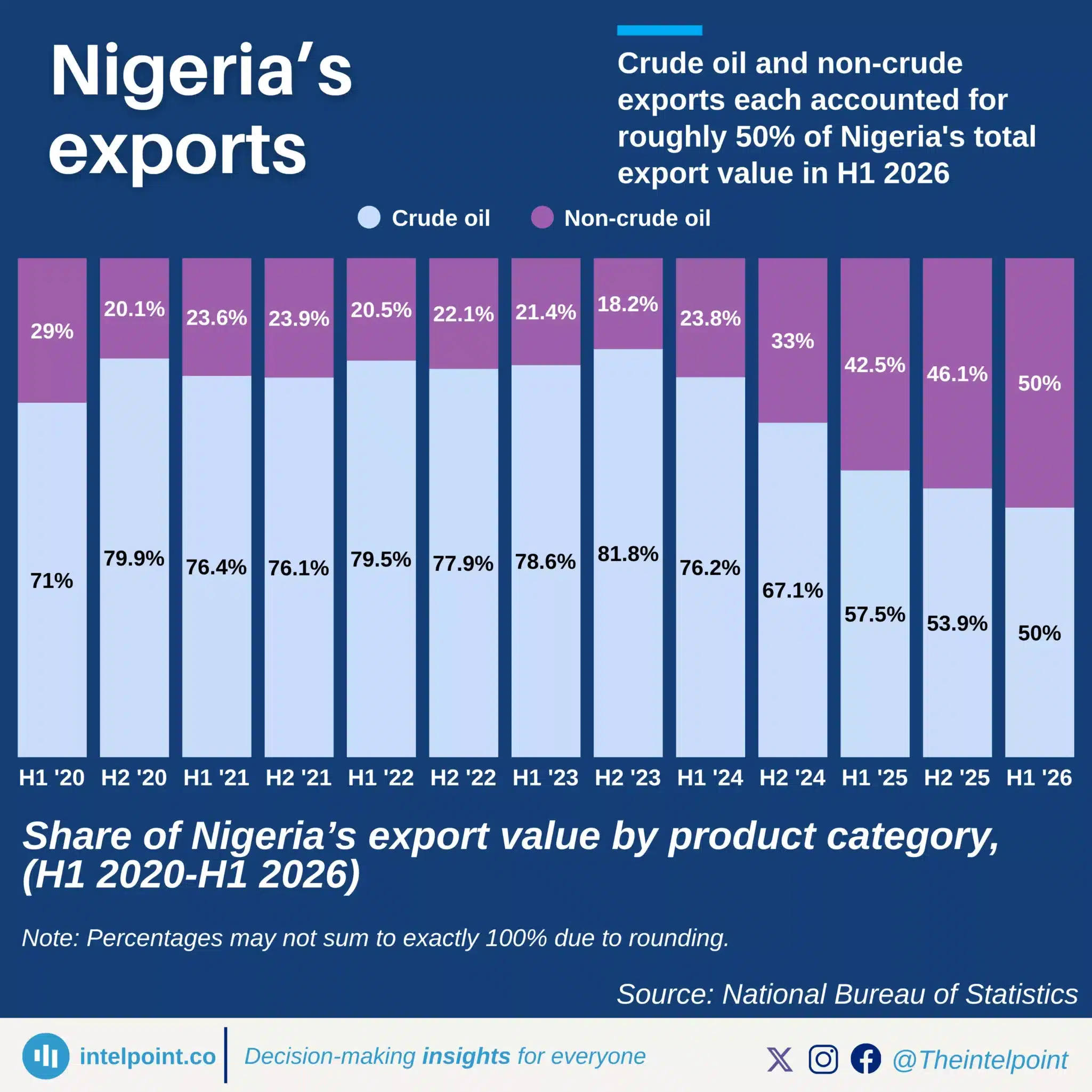
Nigeria’s export mix stayed oil-heavy in 2025, with crude oil above 75% in all quarters
  • Crude oil dominated Nigeria’s exports in all quarters of 2025
  • Q1 recorded the highest oil dependency at 81.5%.
  • Non-oil exports peaked in Q2 at 24.2%, representing the strongest diversification point in 2025.
  • The oil share dropped to its lowest in Q2 (75.8%), but still remained dominant.

In 2025, Nigeria imported crude oil for the first time in the past decade, accounting for 11% of its total crude oil trade
Key takeaways:
  • Nigeria recorded its first crude oil imports in a decade in 2025, marking a structural shift in trade dynamics.
  • Imports accounted for 11% of total crude oil trade in 2025.
  • Total crude oil trade grew sharply from ₦7 trillion in 2016 to ₦53.2 trillion in 2025, indicating long-term expansion.
  • Exports remain dominant, contributing ₦47.4 trillion in 2025 despite the emergence of imports.
  • 2024 was the peak year for crude oil trade at ₦55.3 trillion, followed by a slight decline in 2025.
  • The 2020 dip of ₦9.4 trillion highlights vulnerability to global shocks, likely tied to oil price and demand disruptions.

Nigeria exported ₦47tn in crude, yet spent ₦45tn importing finished goods and refined petroleum
  • Crude oil alone accounts for 55.7% of all exports. Remove it and Nigeria runs a ₦26.7tn trade deficit. The entire surplus rests on one commodity.
  • Nigeria imports ₦31.97tn in manufactured goods but exports only ₦2.50tn, a 12-to-1 ratio that reflects near-total dependence on foreign industrial output.
  • Nigeria exports ₦25.3tn in petroleum products yet imports ₦13.3tn of refined petroleum. Africa's top oil producer still can't fully process its own crude.
  • Despite Nigeria's vast farmland, agri-exports (₦5.07tn) barely exceed agri-imports (₦4.76tn). The sector earns almost nothing net.

POPULAR TOPICS
SIGN UP TO OUR NEWSLETTER
Get periodic updates about the African startup space, access to our reports, among others.
Subscribe Here
Subscription Form

A product of Techpoint Africa. All rights reserved