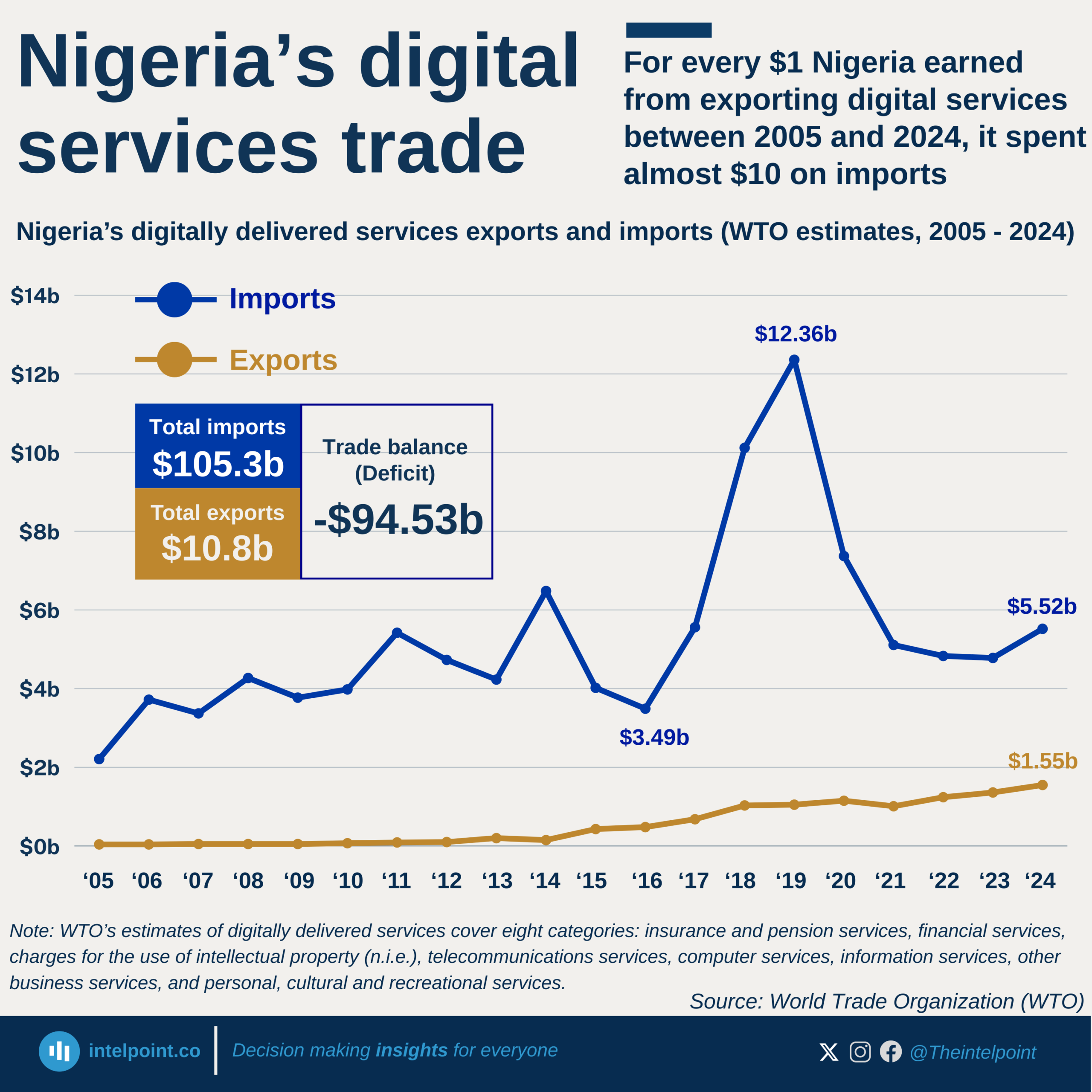
For every $1 Nigeria earned from exporting digital services between 2005 and 2024, it spent almost $10 on imports

  • Nigeria exported $10.81 billion in digital services between 2005 and 2024.
  • Imports during the same period reached $105.34 billion.
  • The result was a trade deficit of $94.53 billion over 20 years.
  • Exports rose from just $40 million in 2005 to $1.55 billion in 2024.
  • Imports were almost ten times larger than exports, showing a persistent imbalance.

Nigeria is heavily dependent on foreign digital services and has not yet built a strong export base to compete in the global digital economy.From 2005 to 2024, Nigeria exported $10.81 billion in digital services but imported $105.34 billion, resulting in a massive trade deficit of $94.53 billion. Exports grew gradually from $40 million in 2005 to $1.55 billion in 2024, yet imports consistently outweighed them, peaking at $12.36 billion in 2019.

The widening gap reflects Nigeria's limited ability to capture value from the global digital economy.
Source:

World Trade Organization (WTO)

Period:

1970-2023
HTML code to embed chart
Want a bespoke report?
Reach out
Tags
Related Insights

Nearly 60% of X’s Ad audience across Africa’s top 10 markets is concentrated in Nigeria, Egypt, and South Africa
  1. Nigeria ranks first with 7.3 million estimated users — over 2.8 million more than Egypt.
  2. Egypt (4.5 million) and South Africa (3.1 million) follow, forming the top three markets.
  3. The top three countries account for nearly 60% of the total users across the ten listed countries.
  4. The gap between first (7.3 million) and tenth (Tunisia, 322,000) is more than 6.9 million users, highlighting wide market disparities.

South Africa accounts for 22% of Africa’s 282 data centres
  • South Africa leads with 61 facilities, accounting for 21.6% of the continent’s total
  • Nigeria (25) and Kenya (19) complete the top three countries with major digital infrastructure hubs
  • Many countries operate with fewer than five facilities
  • Eighteen countries have just one data centre each
  • As cloud adoption, fintech, streaming, and AI grow, new regional hubs are likely to emerge beyond today’s leaders.

South Africa accounts for 25% of Africa’s 249 data centres
  • Africa had 249 data centres as of February 2026
  • South Africa leads with 61 facilities, accounting for 25% of the continent’s total
  • Nigeria (25) and Kenya (19) complete the top three countries with major digital infrastructure hubs
  • Many countries operate with fewer than five facilities
  • A dozen countries have just one data centre
  • Infrastructure concentration means cross-border data dependence for many smaller economies.
  • As cloud adoption, fintech, streaming, and AI grow, new regional hubs are likely to emerge beyond today’s leaders.

Rack Centre leads Nigeria’s data centre in live capacity at 13.5 MW across its 2 centres
  • Rack Centre leads Nigeria’s live capacity with 13.5 MW
  • Africa Data Centres (10 MW) and Equinix (8.8 MW) form the next tier of large operators
  • Lagos dominates capacity, reinforcing its role as Nigeria’s primary digital infrastructure hub
  • Several operators have major expansion plans, including Africa Data Centres (+10.65 MW addition) and OADC Lagos (+24.5 MW addition)

Lagos houses 21 of 25 data centres, accounting for 84% of the nation’s centres
  • Lagos hosts 21 of Nigeria’s 25 data centres.
  • Only Lagos, Abuja, and Kano currently host data centres.
  • Abuja holds 12% of the country’s data centres despite being the capital.
  • Kano’s single facility accounts for just 4% and highlights the limited digital infrastructure in northern Nigeria.
  • The distribution shows a high geographic concentration risk; national digital operations rely heavily on Lagos.
  • Lagos’ dominance reflects its advantages: commercial activity, connectivity, and proximity to submarine cable landings.

After three years of decline, China-Nigeria export trade hit a new peak of $24.9bn in 2025
  • Export value more than doubled from $9.72 billion in 2016 to $24.91 billion in 2025.
  • Trade rose steadily between 2016 and 2019, then surged sharply in 2021.
  • Exports declined for three consecutive years (2022–2024) after the 2021 peak.
  • 2025 marks the highest export value in the ten-year period.

POPULAR TOPICS
SIGN UP TO OUR NEWSLETTER
Get periodic updates about the African startup space, access to our reports, among others.
Subscribe Here
Subscription Form

A product of Techpoint Africa. All rights reserved