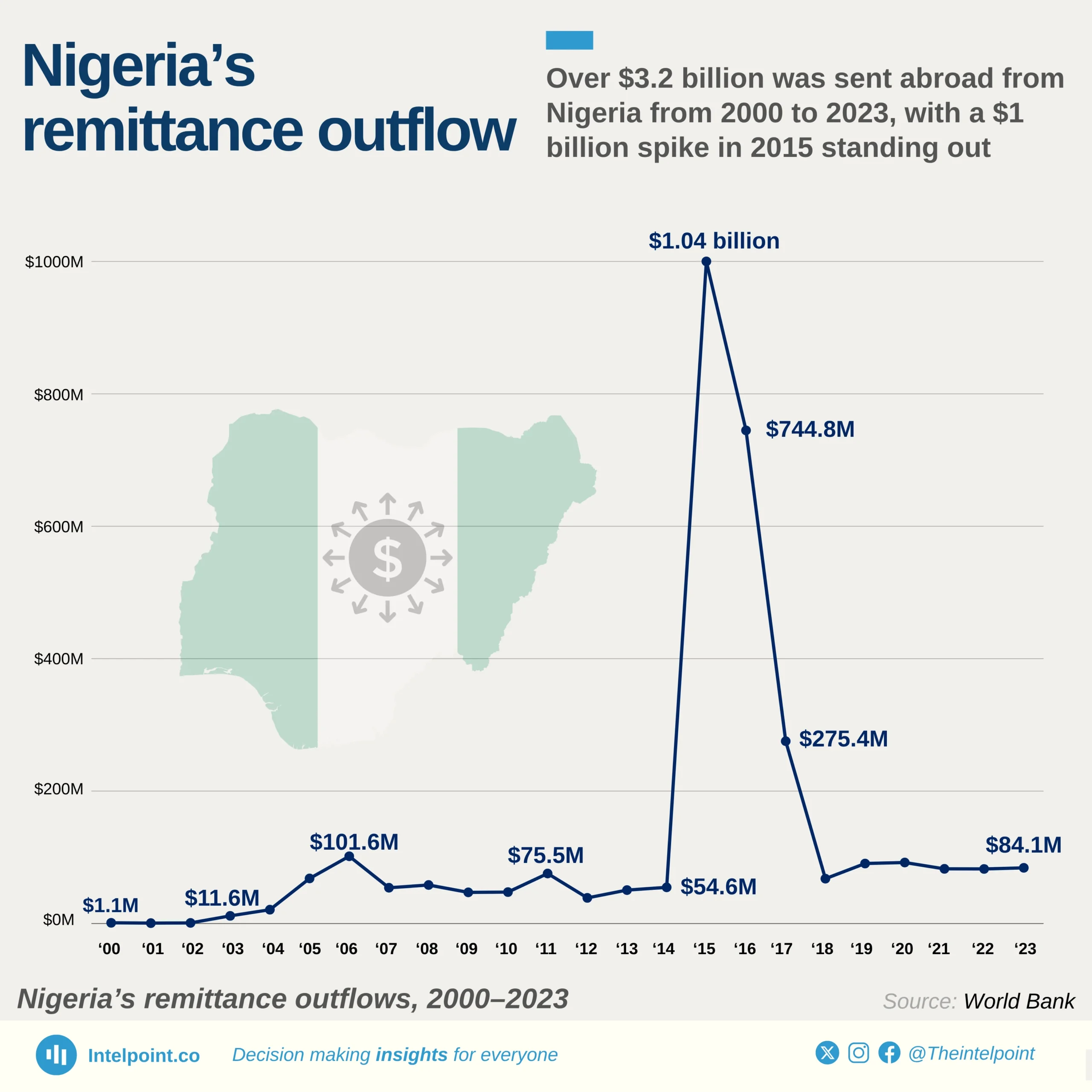
Over $3.2 billion was sent abroad from Nigeria from 2000 to 2023, with a $1 billion spike in 2015 standing out

Key takeaways

  • Migrants living in Nigeria sent out over $3.2 billion in personal remittances between 2000 and 2023.
  • The year 2015 recorded a sharp and unusual outflow of $1.04 billion, the highest by far in the entire 24-year span.
  • After 2015, remittance outflows sharply declined, stabilising below $100 million from 2018 onward.
  • Prior to 2015, outflows were consistently under $110 million annually, indicating a major anomaly in that spike year.

Between 2000 and 2023, personal remittance outflows from Nigeria amounted to over $3.2 billion, a reflection of the funds sent by migrant workers or foreign nationals residing in Nigeria to their families or communities abroad. These outflows remained relatively modest until 2015, when the data showed an extraordinary surge: over $1.04 billion was sent out that year alone, more than 30% of the total recorded over two decades.

This spike could indicate a unique economic or policy event, possibly related to capital flight, currency concerns, or foreign labour transitions during that period. Following 2015, remittance outflows gradually dropped, and by 2018, they settled into a more stable range, hovering around $80–90 million annually. This trend suggests that the 2015 spike was an outlier in an otherwise modest and steady remittance outflow landscape for Nigeria.
Source:

World Bank

Period:

2000 to 2023
HTML code to embed chart
Want a bespoke report?
Reach out
Tags
Related Insights

Nigeria’s power grid is 69.9% powered by thermal plants
  • Thermal energy dominates Nigeria’s grid, supplying 69.9% of total power.
  • Hydro plants contribute 30.1%, making them the country’s second major source.
  • The heavy reliance on thermal generation shows Nigeria’s grid is still largely fossil-fuel driven.
  • Hydro remains a crucial but secondary source, supporting overall supply stability.

Nigeria's DisCos recorded ₦360bn revenue gap after collecting ₦1.12tn from ₦1.49tn billed in H1 2025
  • DisCos billed approximately ₦1.49 trillion but collected only ₦1.12 trillion in H1 2025.
  • Ikeja and Eko DisCos generated the highest revenues, collecting ₦206.22 billion and ₦210.59 billion, respectively.
  • Revenue collection gaps remain significant, with Jos, Kaduna, and Yola posting the weakest collection performances.
  • The wide gap between billings and actual collections suggests persistent challenges in customer payment compliance, metering, and distribution efficiency.

Nigeria has installed 3.65 million electricity metres since 2019; Ikeja DisCo leads with 823,000, and Aba Power at the bottom with 56,000
  • Approximately 3.65 million metres have been installed nationwide across all frameworks since 2019.
  • Ikeja DisCo leads by a wide margin with 823,000 installations, over twice the volume of most other DisCos.
  • Kaduna, Yola, and Aba Power recorded the lowest metre installations, each below 100,000.
  • The disparities in installation totals reveal uneven progress in achieving nationwide metering coverage.

More than 8 in 10 electricity customers of Ikeja and Eko DisCos are now metered
  • Ikeja (84.6%) and Eko (83.3%) lead Nigeria’s metering performance, keeping unmetered customers below 17%.
  • Eight out of the twelve DisCos have metering rates below 60%, showing a wide sector imbalance.
  • The worst-performing DisCos — Yola, Jos, Kaduna, and Kano — have over 65% unmetered customers.
  • Regional disparities are sharp: Lagos and Abuja outperform northern and south-eastern DisCos by large margins.

West Africa has the highest concentration of remittance-dependent nations, with 10 countries in the top 20, led by The Gambia (21.1%)
  • The Gambia leads Africa in remittance-GDP ratio, with remittance accounting for 21.1% of its GDP in 2024.
  • Lesotho (20.9%) and Comoros (18.3%) closely follow as highly remittance-dependent economies.
  • Somalia (17.5%) and Liberia (14.3%) also rely heavily on diaspora inflows to support their economies.
  • Nigeria (11.3%) remains a major player, highlighting its strong global diaspora network.
  • Cabo Verde (12.1%) and Senegal (11.6%) demonstrate that remittances are key drivers of income in smaller economies.
  • In larger economies like Egypt (7.6%) and Morocco (8.1%), remittances also make up a significant share of GDP.

In 2024, West African nations hold six spots of the top 15 Africa's Importance of Remittance Index, led by Senegal (77)
  • West Africa dominates Africa’s top 15, holding six positions on the remittance importance index.
  • Zimbabwe (78) ranks as Africa’s top country in terms of remittances' importance.
  • Senegal (77) and Nigeria (72) highlight the central role of diaspora inflows in West Africa’s economies.
  • Morocco (74) leads North Africa in remittance importance.
  • Smaller nations like Lesotho (68) and Liberia (68) depend heavily on remittances relative to their GDP.
  • The lowest-ranked countries, including Angola (9) and Djibouti (11), rely minimally on remittance inflows.

POPULAR TOPICS
SIGN UP TO OUR NEWSLETTER
Get periodic updates about the African startup space, access to our reports, among others.
Subscribe Here
Subscription Form

A product of Techpoint Africa. All rights reserved