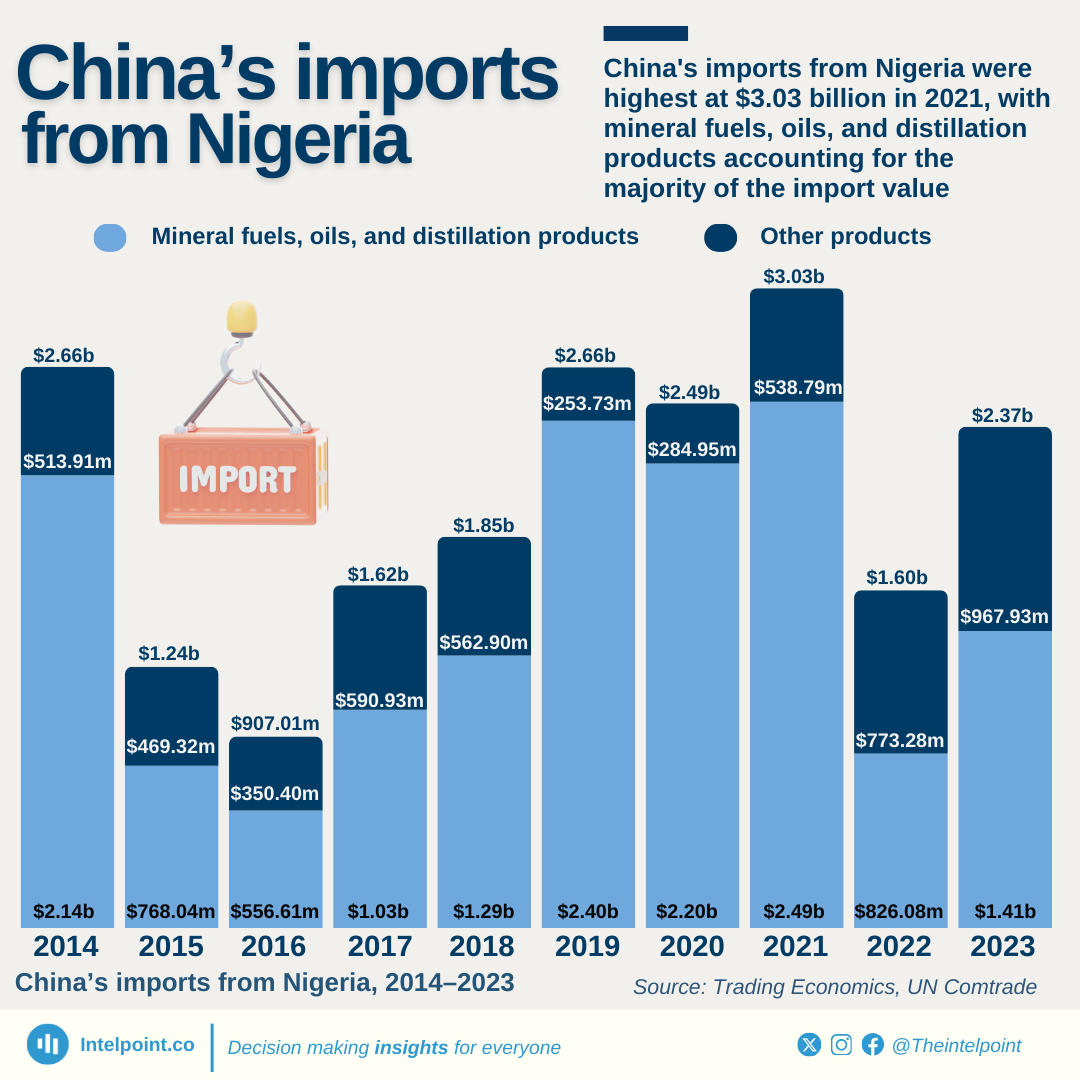
China's imports from Nigeria were highest at $3.03 billion in 2021, with mineral fuels, oils, and distillation products accounting for the majority of the import value

Key Takeaways:

  • From 2014 to 2023, China’s imports from Nigeria fluctuated significantly, ranging between $907 million and over $3 billion.
  • A sharp 53% drop was recorded between 2014 and 2015, followed by a further decline to a decade-low in 2016.
  • China reached its highest import value in 2021, when it imported over $3 billion from Nigeria.
  • Imports fell by 47% in 2022 but recovered by 48% in 2023, reaching $2.37 billion.
  • The volatility in trade reflects the influence of global commodity prices, especially oil, and evolving bilateral trade dynamics.
  • Mineral fuels, oils, and distillation products accounted for more than 50% of China's imports from Nigeria during the period of study.

Between 2014 and 2023, China’s imports from Nigeria showed a highly volatile trend. In 2014, imports stood at $2.66 billion but plummeted by 53% in 2015 and reached a decade-low of $907 million in 2016, likely due to the global oil price crash.

A gradual recovery followed, peaking in 2021 at $3.03 billion, reflecting strong demand for Nigerian raw materials, particularly mineral fuels.

However, imports fell sharply again in 2022 to $1.60 billion, with trade recovering strongly by 48% in 2023 to $2.37 billion.
Source:

Trading Economics, UN Comtrade

Period:

2014-2023
HTML code to embed chart
Want a bespoke report?
Reach out
Tags
Related Insights

After three years of decline, China-Nigeria export trade hit a new peak of $24.9bn in 2025
  • Export value more than doubled from $9.72 billion in 2016 to $24.91 billion in 2025.
  • Trade rose steadily between 2016 and 2019, then surged sharply in 2021.
  • Exports declined for three consecutive years (2022–2024) after the 2021 peak.
  • 2025 marks the highest export value in the ten-year period.

China's top 10 African export destinations take about 66% of its exports to the continent in 2025
  • Nigeria leads by a clear margin, receiving the highest export value at $24.91bn.
  • Large, diversified economies dominate the top tier, with South Africa and Egypt ranking among the biggest destinations.
  • Resource-linked trade remains significant, with countries like Liberia and Algeria absorbing substantial export value.
  • Trade reach is geographically diverse, spanning West, East, and North Africa, including GhanaTanzaniaKenyaMorocco, and Guinea.

Post-pandemic trade reset lifts China–Africa exports to a record $225bn in 2025
  • Exports more than doubled in a decade, with trade rising from $92.27 billion in 2016 to $225 billion in 2025, a 144% increase.
  • The largest single jump occurred between 2020 and 2021, when exports surged by more than $34 billion.
  • From 2021 to 2024, exports climbed every year, reaching $178.91 billion before the latest surge.
  • The increase from $178.91 billion in 2024 to $225 billion in 2025 signals a new growth surge after several years of gradual increases.

Agricultural products led Kenya’s 2024 export economy, with coffee, tea, and spices generating $1.7 bn
  • Agriculture dominated Kenya’s exports, with coffee, tea, and spices alone contributing $1.7 billion, the largest single export category.
  • Mineral fuels were a surprisingly strong second, delivering $1.1 billion, and showing Kenya’s growing role in regional fuel distribution.
  • Horticultural exports (flowers, live plants, and trees) contributed $790 million, reinforcing Kenya’s global strength in floriculture.
  • All other export categories fall below $300 million individually, reflecting a long list of small but diverse export segments such as textiles, vegetables, and pharmaceuticals.

Mining led South Africa’s 2024 exports with 18.7%, as gems and precious metals generated over $20 bn
  • Gems and precious metals were the largest single export category, contributing $20.6 billion.
  • Ores and industrial minerals followed closely with $17.2 billion, showing the country’s reliance on mining.
  • Vehicles and machinery were significant non-mineral exports, with a combined $18.3 billion.
  • Agricultural and light industry products like fruits, nuts, and beverages contributed modestly, strengthening mining and manufacturing’s position as the core export drivers.

Cocoa accounted for 4.6% of Nigeria’s 2024 exports, making it the country’s second-largest export after oil
  • Mineral fuels (including crude oil) accounted for $49.3 billion, or 86.8% of total exports in 2024.
  • Non-oil exports remained marginal, with the second-largest item, cocoa, contributing only 4.6%.
  • Fertilisers, ores, slag, ash, and oilseeds collectively made up less than 5%, indicating limited diversification.
  • All other export categories each contributed 1% or less, underscoring Nigeria’s narrow export base.

POPULAR TOPICS
SIGN UP TO OUR NEWSLETTER
Get periodic updates about the African startup space, access to our reports, among others.
Subscribe Here
Subscription Form

A product of Techpoint Africa. All rights reserved