Africa’s remittance boom: From $9.7 billion to nearly $100 billion in 2021

Africa's remittance inflow nearly reached $100 billion in 2021, driven by contributions from Nigeria, Egypt, and Morocco, the top recipients on the continent.

Growing from $9.7 billion in 2000 to $97.6 billion in 2021, highlights the crucial role of the African diaspora.
Source:

World Bank-KNOMAD

Period:

2000 - 2023
HTML code to embed chart
Want a bespoke report?
Reach out
Tags
Related Insights

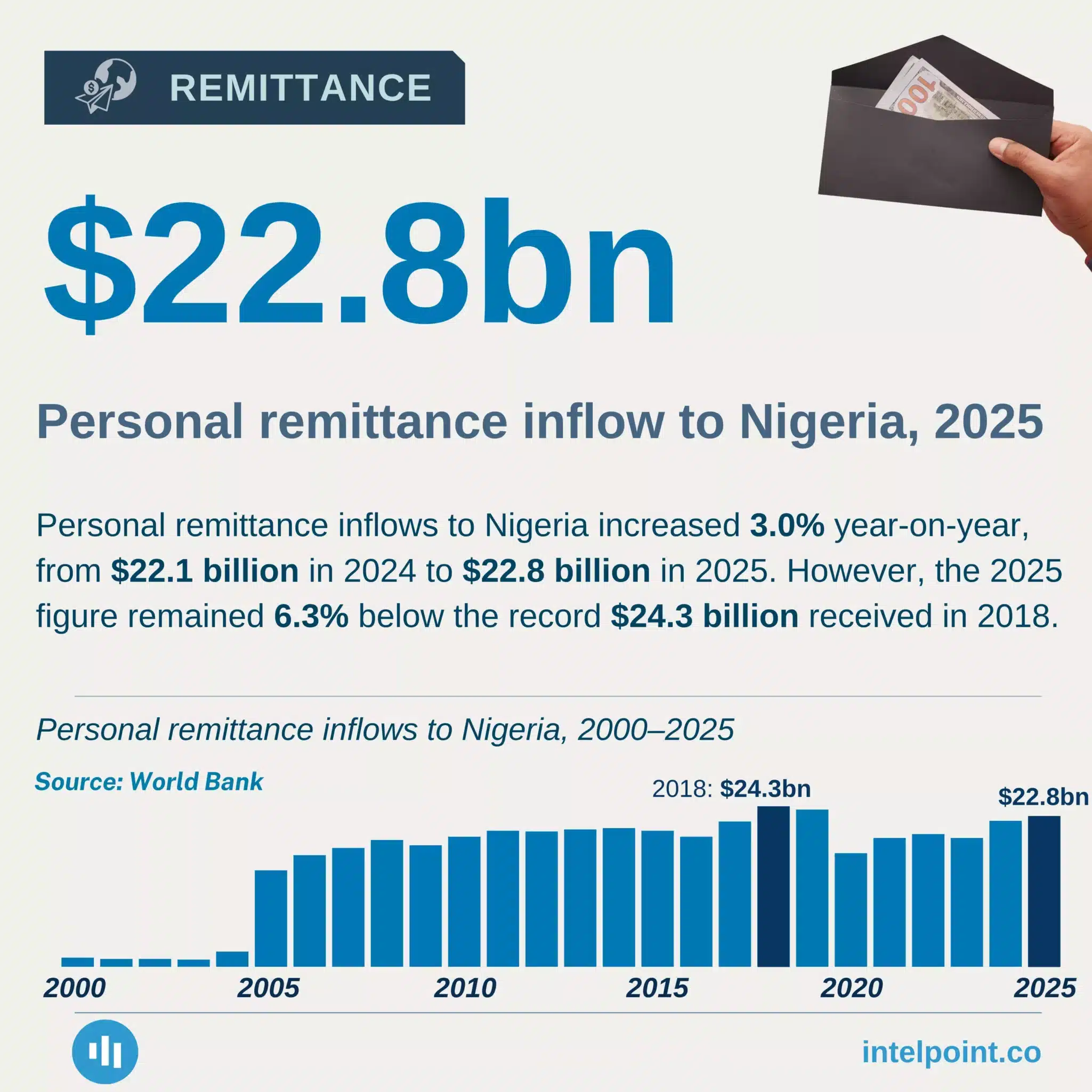
Personal remittance inflows to Nigeria increased 3.0% year-on-year, from $22.1 billion in 2024 to $22.8 billion in 2025
  • Nigeria received $22.8 billion in personal remittances in 2025; a 3% year-on-year increase
  • Inflows remained 6.3% below the 2018 record of $24.3 billion.
  • Remittances have recovered from the $17.2 billion recorded in 2020.
  • Nigeria’s 2025 remittance inflows were 32.6% higher than in 2020.
  • Remittances accounted for 7.8% of GDP in 2025.
  • Remittances’ share of GDP fell from 8.8% in 2024.
  • Remittances’ share of GDP remained above the 4.0% recorded in 2023.

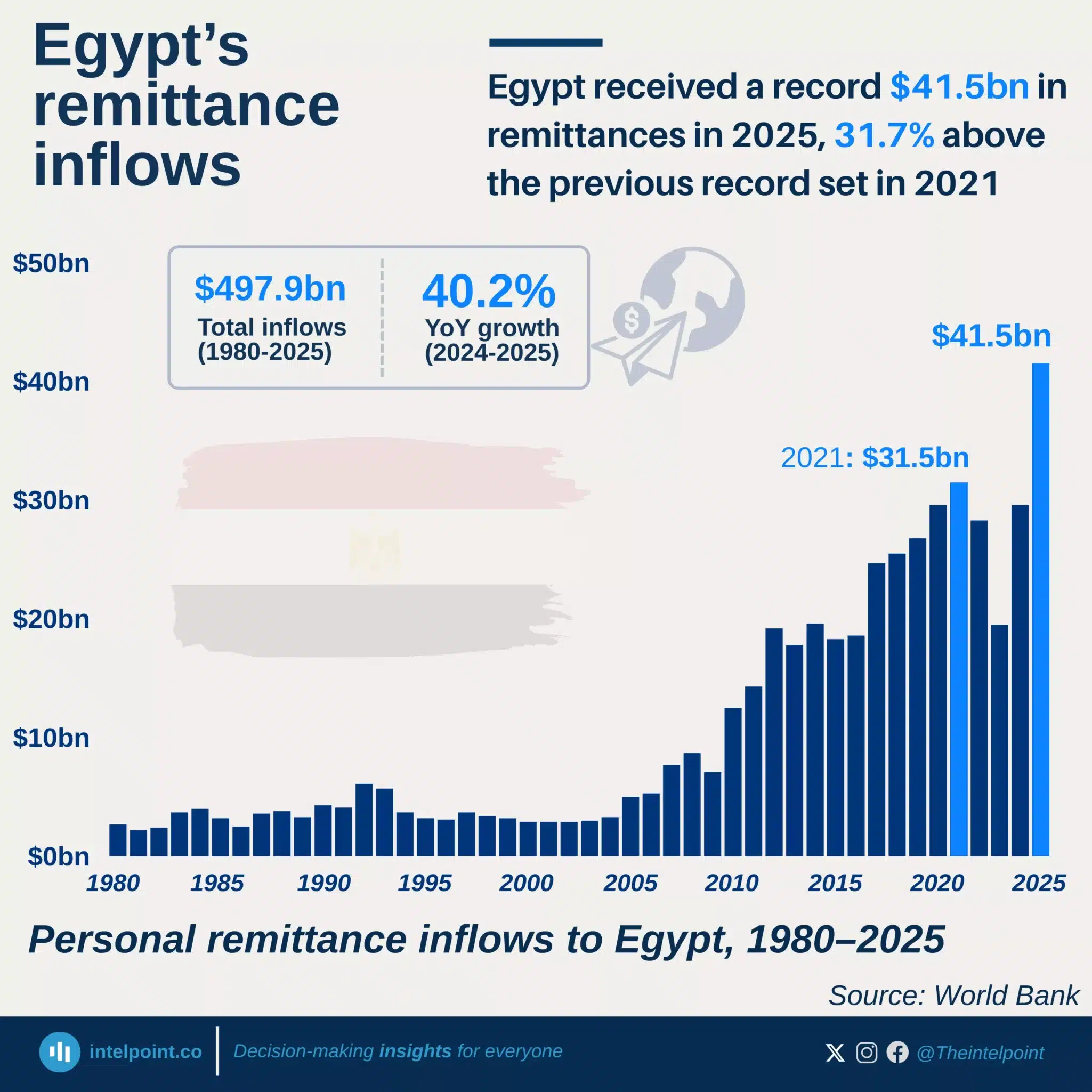
Egypt received a record $41.5bn in remittances in 2025, 31.7% above the previous record set in 2021
  • Egypt received a record $41.5 billion in remittances in 2025.
  • Remittances increased 40.2% from 2024.
  • The 2025 inflow was 31.7% above the previous record set in 2021.
  • Remittances fell to $19.5 billion in 2023 before rebounding sharply.
  • Remittances more than doubled between 2023 and 2025.
  • Egypt received about $497.9 billion in remittances from 1980 to 2025.
  • The March 2024 FX reforms preceded the sharp recovery in remittance inflows.
  • 2025 marked the highest annual remittance inflow in the series.

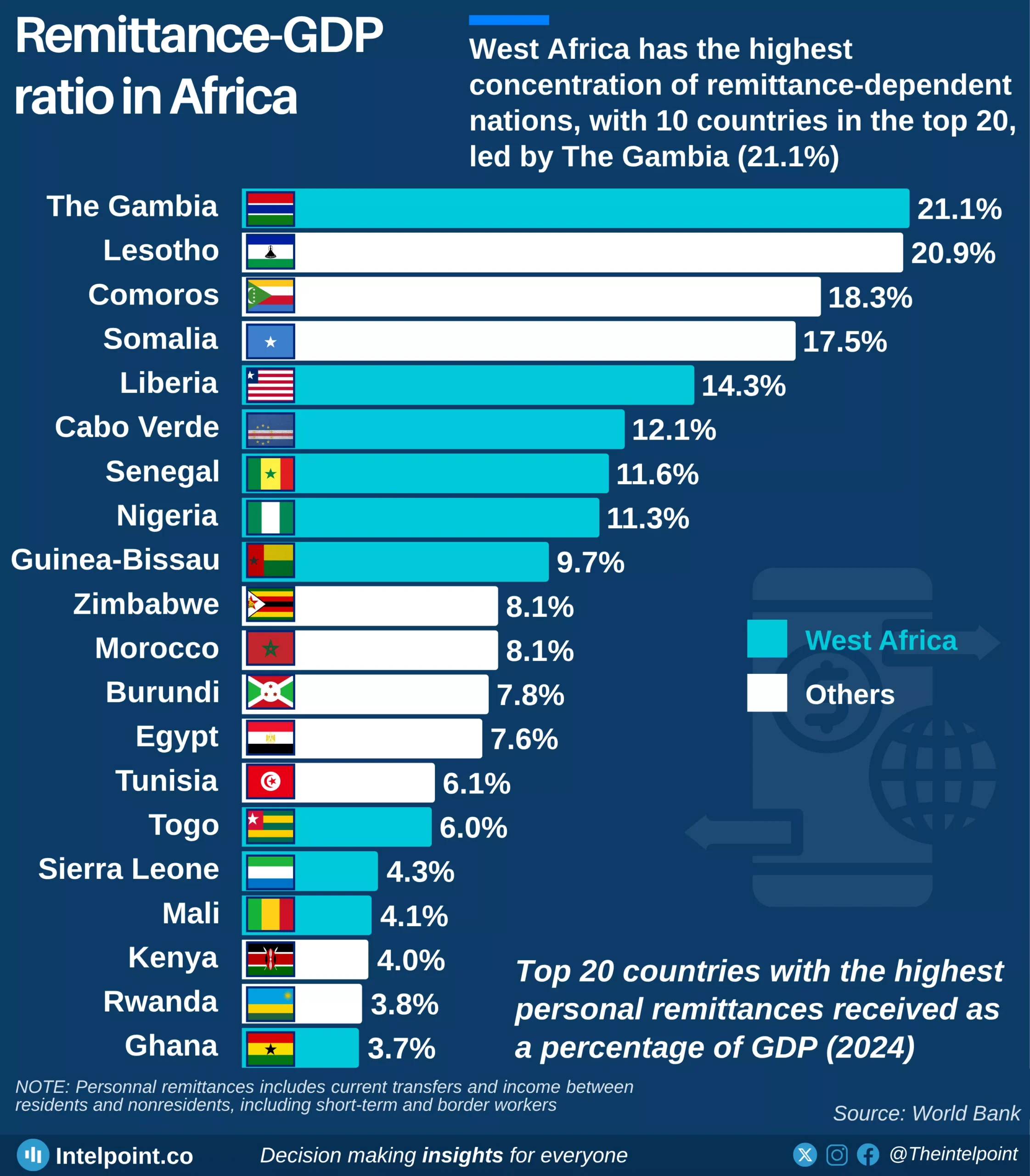
West Africa has the highest concentration of remittance-dependent nations, with 10 countries in the top 20, led by The Gambia (21.1%)
  • The Gambia leads Africa in remittance-GDP ratio, with remittance accounting for 21.1% of its GDP in 2024.
  • Lesotho (20.9%) and Comoros (18.3%) closely follow as highly remittance-dependent economies.
  • Somalia (17.5%) and Liberia (14.3%) also rely heavily on diaspora inflows to support their economies.
  • Nigeria (11.3%) remains a major player, highlighting its strong global diaspora network.
  • Cabo Verde (12.1%) and Senegal (11.6%) demonstrate that remittances are key drivers of income in smaller economies.
  • In larger economies like Egypt (7.6%) and Morocco (8.1%), remittances also make up a significant share of GDP.

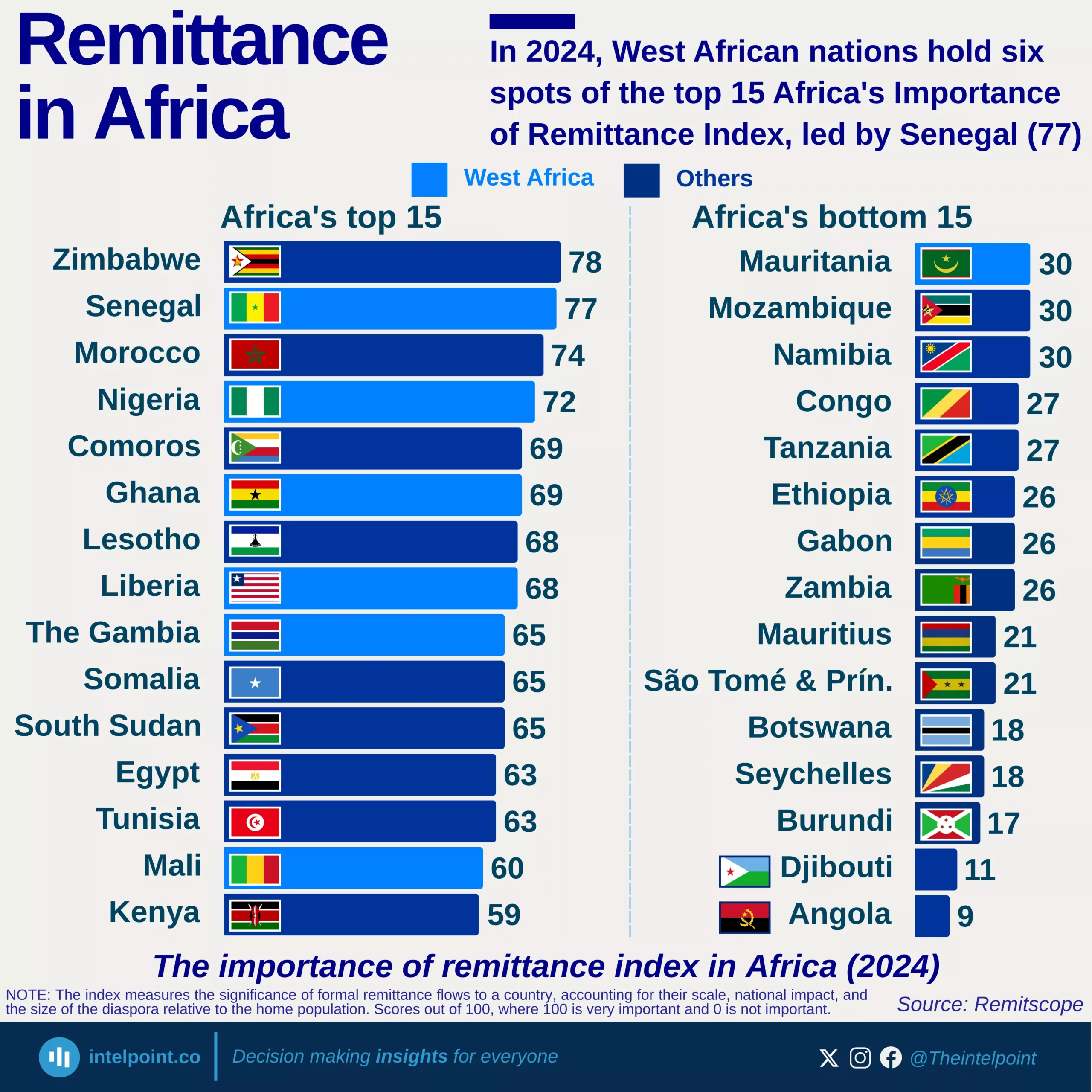
In 2024, West African nations hold six spots of the top 15 Africa's Importance of Remittance Index, led by Senegal (77)
  • West Africa dominates Africa’s top 15, holding six positions on the remittance importance index.
  • Zimbabwe (78) ranks as Africa’s top country in terms of remittances' importance.
  • Senegal (77) and Nigeria (72) highlight the central role of diaspora inflows in West Africa’s economies.
  • Morocco (74) leads North Africa in remittance importance.
  • Smaller nations like Lesotho (68) and Liberia (68) depend heavily on remittances relative to their GDP.
  • The lowest-ranked countries, including Angola (9) and Djibouti (11), rely minimally on remittance inflows.

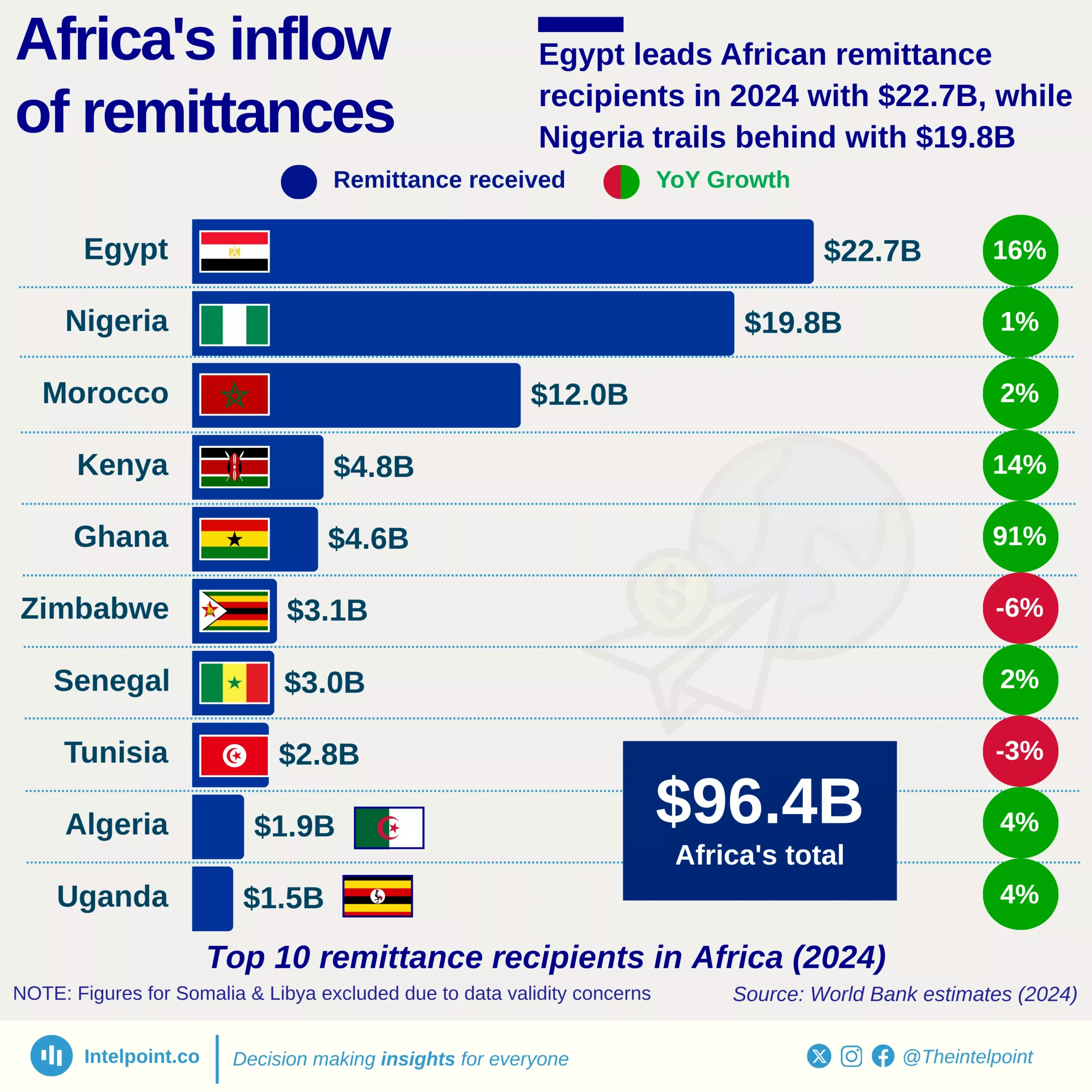
Egypt leads African remittance recipients in 2024 with $22.7B, while Nigeria trails behind with $19.8B
  • Africa received $96.4 billion in remittances in 2024.
  • Egypt ($22.7B) and Nigeria ($19.8B) dominated inflows, accounting for nearly half of the continent’s total.
  • Egypt’s 16% growth reflects stronger remittance networks and economic linkages with its diaspora.
  • Nigeria’s inflows grew modestly (1%).
  • Ghana recorded the highest growth (91%), indicating a resurgence in diaspora remittances.
  • Zimbabwe (-6%) and Tunisia (-3%) experienced declines, pointing to potential disruptions in inflow channels.

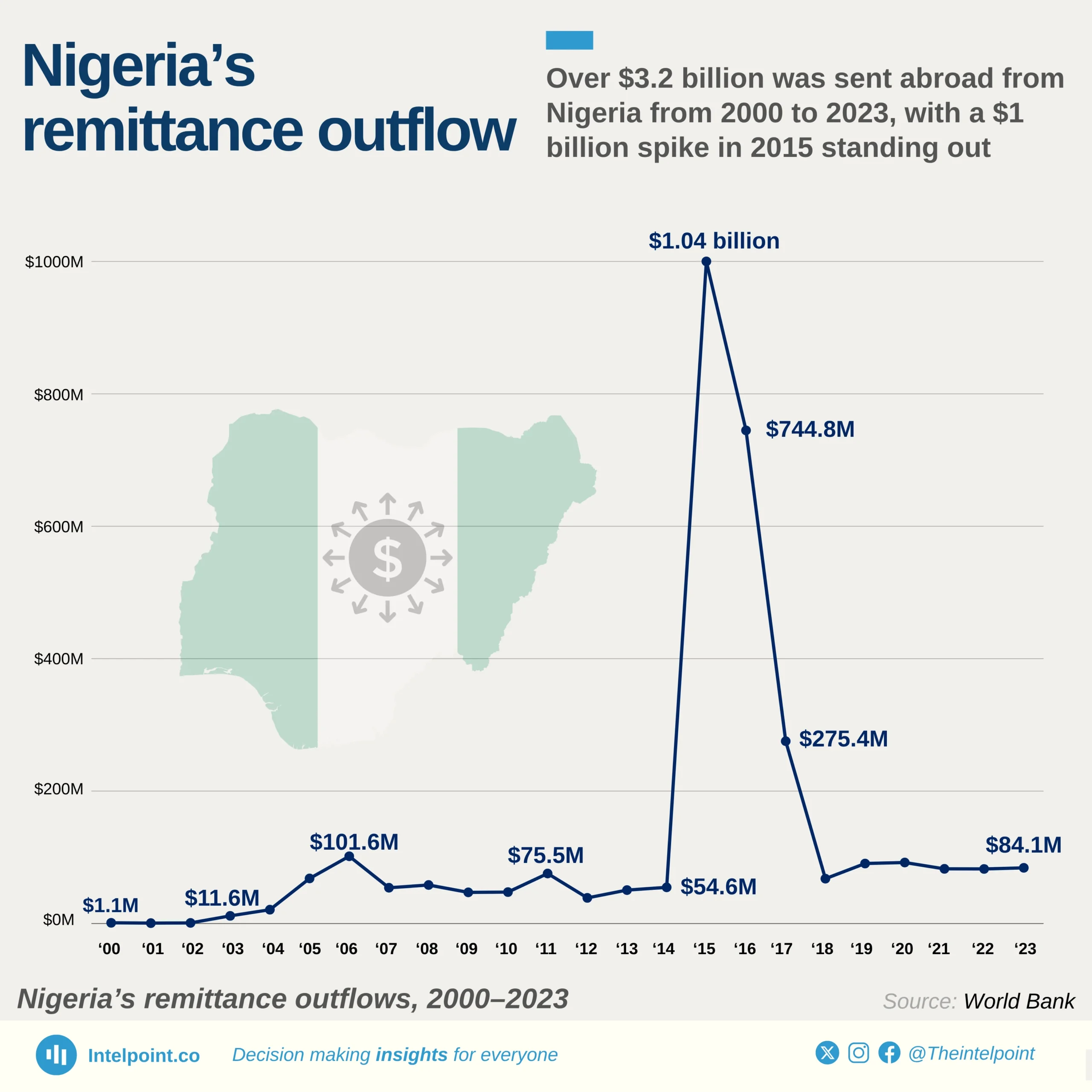
Over $3.2 billion was sent abroad from Nigeria from 2000 to 2023, with a $1 billion spike in 2015 standing out
  • Migrants living in Nigeria sent out over $3.2 billion in personal remittances between 2000 and 2023.
  • The year 2015 recorded a sharp and unusual outflow of $1.04 billion, the highest by far in the entire 24-year span.
  • After 2015, remittance outflows sharply declined, stabilising below $100 million from 2018 onward.
  • Prior to 2015, outflows were consistently under $110 million annually, indicating a major anomaly in that spike year.

POPULAR TOPICS
SIGN UP TO OUR NEWSLETTER
Get periodic updates about the African startup space, access to our reports, among others.
Subscribe Here
Subscription Form

A product of Techpoint Africa. All rights reserved