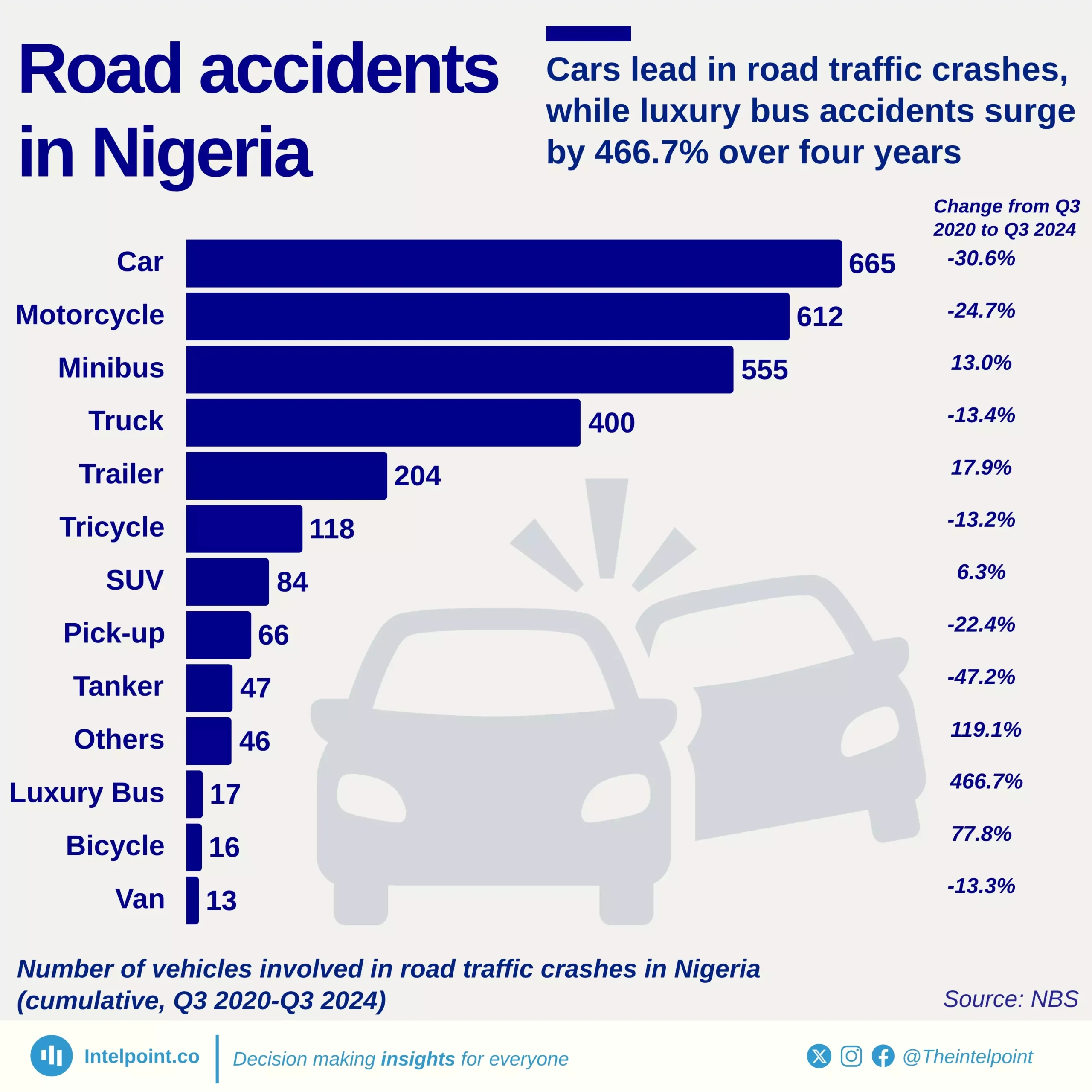
Cars lead in road traffic crashes, while luxury bus accidents surge by 466.7% over four years

Key Takeaways

  • Cars were involved in the highest number of road accidents, recording 665 cases over the four-year period.
  • Luxury buses and bicycles recorded the highest quarter-on-quarter (QoQ) growth in accident involvement.
  • Tankers, cars, and motorcycles saw the sharpest QoQ declines, with accident rates falling by 47.2%, 30.6%, and 24.7% respectively.

In Nigeria, cars and motorcycles account for the majority of vehicles involved in road accidents. However, both categories have recorded a notable decline over the four-year period under review.

The decline in motorcycle-related accidents may be linked to the ban on commercial motorcycle operations, popularly known as "okada", in several major cities. Still, the numbers remain relatively high, likely due to continued usage in areas where the ban is not enforced and the growing use of motorcycles for logistics and delivery services.

On the other hand, bicycle-related accidents increased by 77.8%, which may reflect their rising popularity among food delivery platforms like Chowdeck and Glovo.

Most strikingly, luxury buses experienced the highest growth in accident involvement, with a sharp 466.7% increase over the period—an unusual trend that warrants closer attention.
Source:

NBS

Period:

Q3 2020-Q3 2024
HTML code to embed chart
Want a bespoke report?
Reach out
Tags
Related Insights

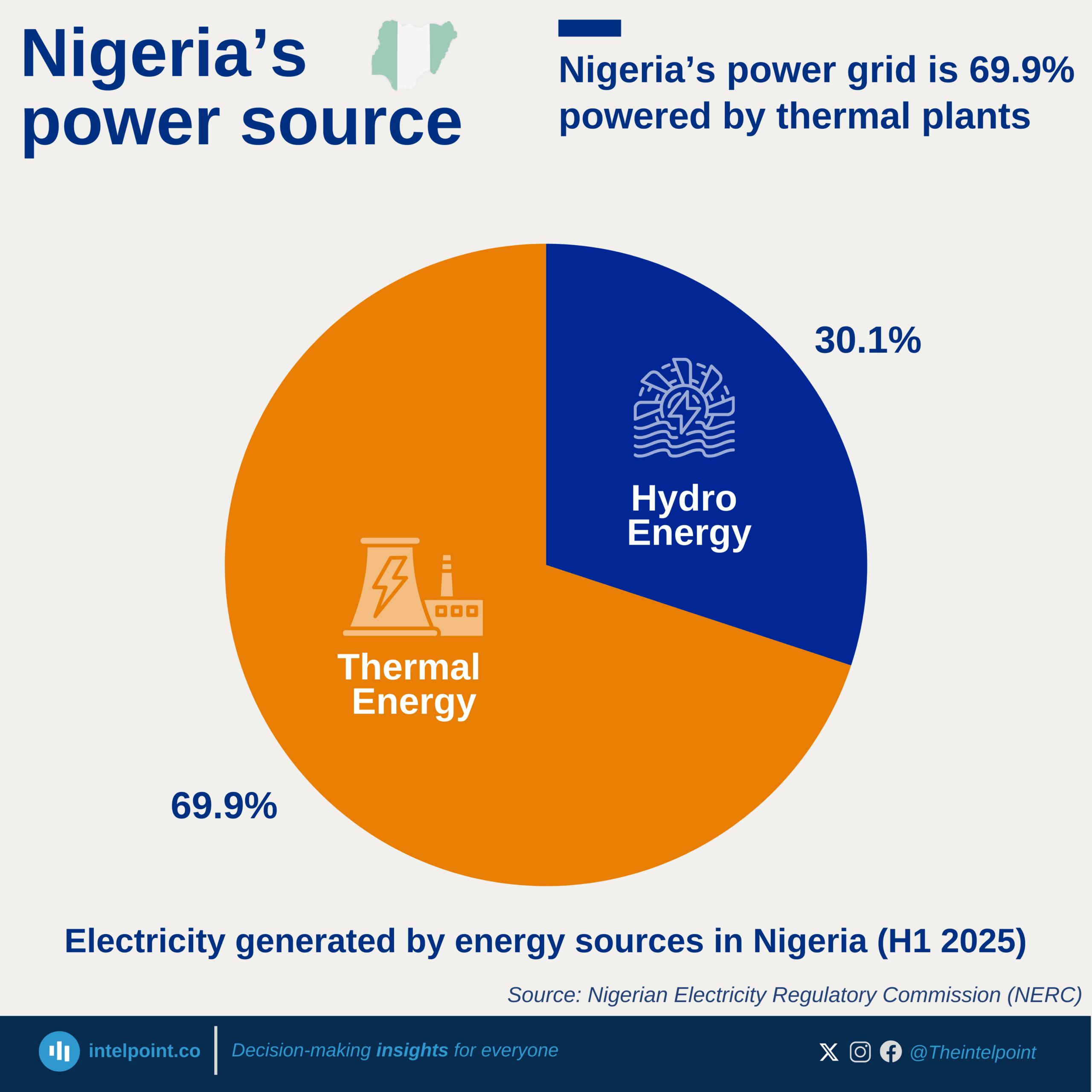
Nigeria’s power grid is 69.9% powered by thermal plants
  • Thermal energy dominates Nigeria’s grid, supplying 69.9% of total power.
  • Hydro plants contribute 30.1%, making them the country’s second major source.
  • The heavy reliance on thermal generation shows Nigeria’s grid is still largely fossil-fuel driven.
  • Hydro remains a crucial but secondary source, supporting overall supply stability.

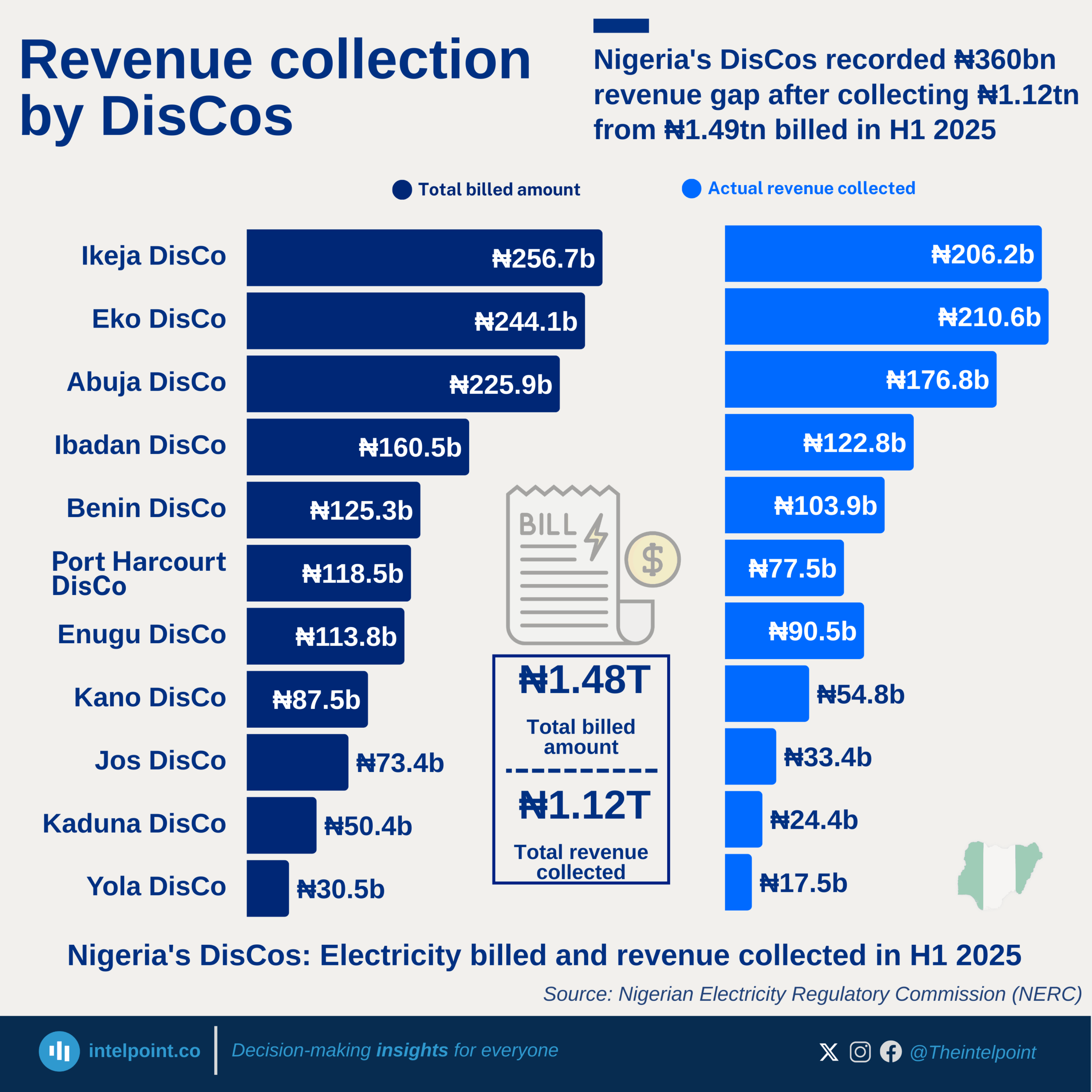
Nigeria's DisCos recorded ₦360bn revenue gap after collecting ₦1.12tn from ₦1.49tn billed in H1 2025
  • DisCos billed approximately ₦1.49 trillion but collected only ₦1.12 trillion in H1 2025.
  • Ikeja and Eko DisCos generated the highest revenues, collecting ₦206.22 billion and ₦210.59 billion, respectively.
  • Revenue collection gaps remain significant, with Jos, Kaduna, and Yola posting the weakest collection performances.
  • The wide gap between billings and actual collections suggests persistent challenges in customer payment compliance, metering, and distribution efficiency.

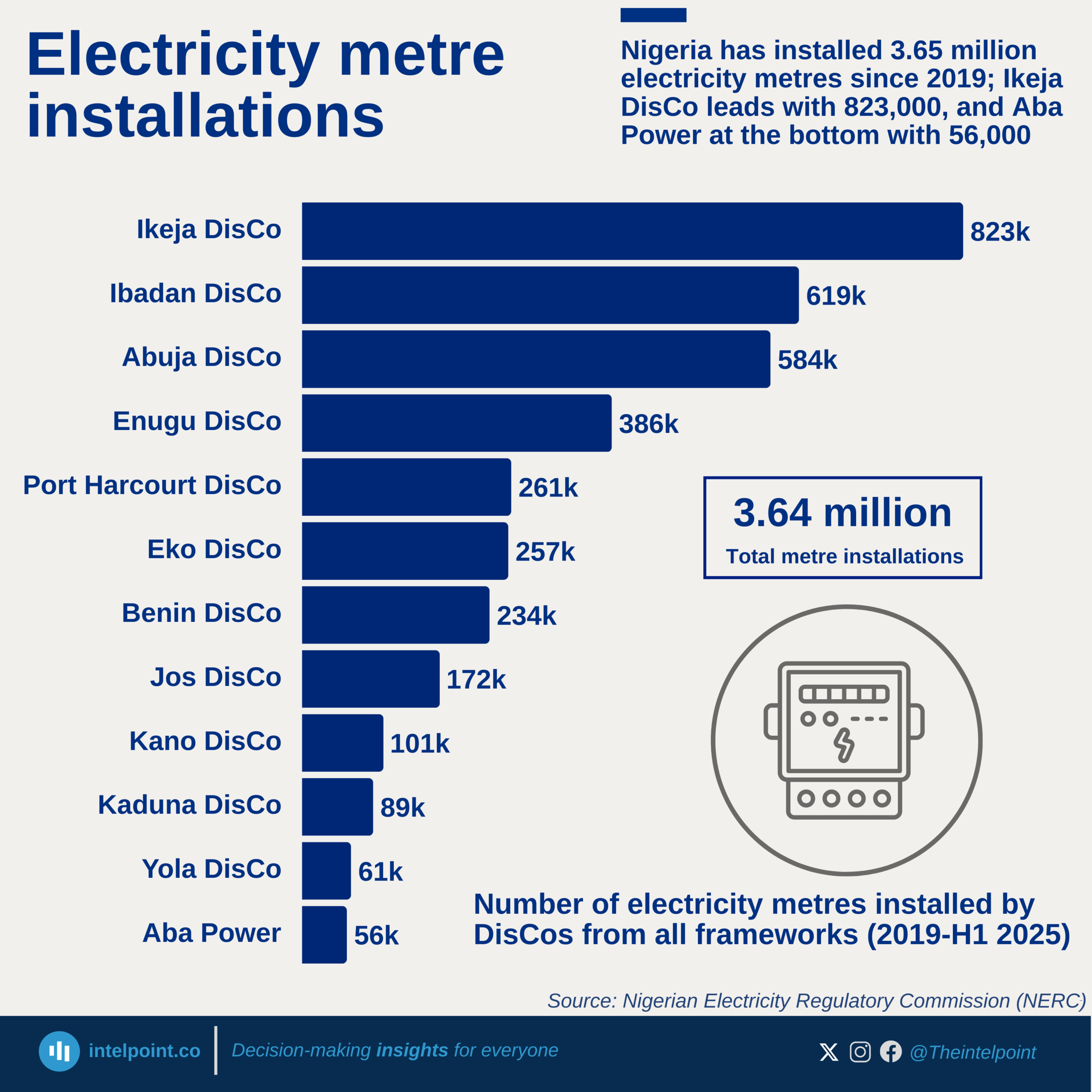
Nigeria has installed 3.65 million electricity metres since 2019; Ikeja DisCo leads with 823,000, and Aba Power at the bottom with 56,000
  • Approximately 3.65 million metres have been installed nationwide across all frameworks since 2019.
  • Ikeja DisCo leads by a wide margin with 823,000 installations, over twice the volume of most other DisCos.
  • Kaduna, Yola, and Aba Power recorded the lowest metre installations, each below 100,000.
  • The disparities in installation totals reveal uneven progress in achieving nationwide metering coverage.

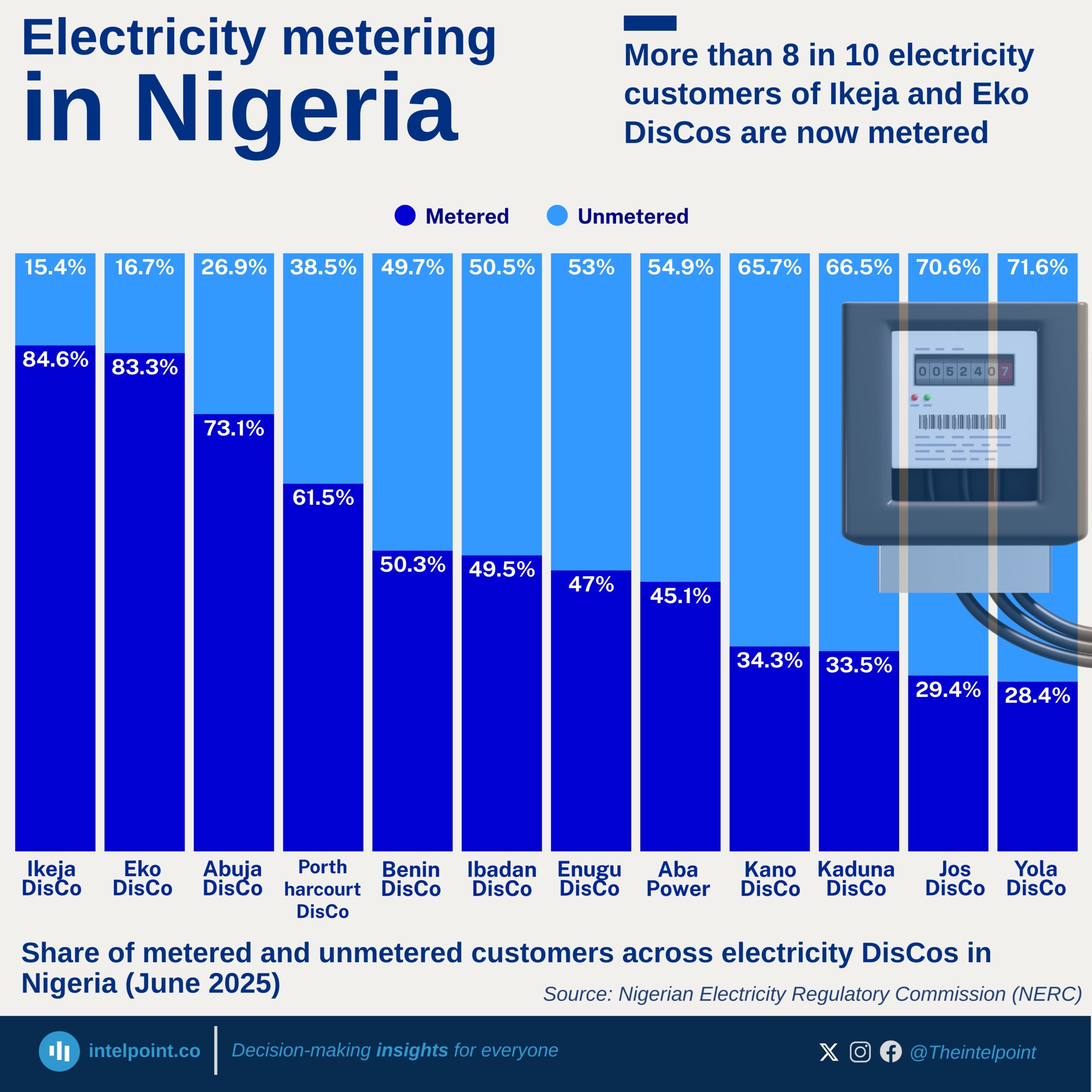
More than 8 in 10 electricity customers of Ikeja and Eko DisCos are now metered
  • Ikeja (84.6%) and Eko (83.3%) lead Nigeria’s metering performance, keeping unmetered customers below 17%.
  • Eight out of the twelve DisCos have metering rates below 60%, showing a wide sector imbalance.
  • The worst-performing DisCos — Yola, Jos, Kaduna, and Kano — have over 65% unmetered customers.
  • Regional disparities are sharp: Lagos and Abuja outperform northern and south-eastern DisCos by large margins.

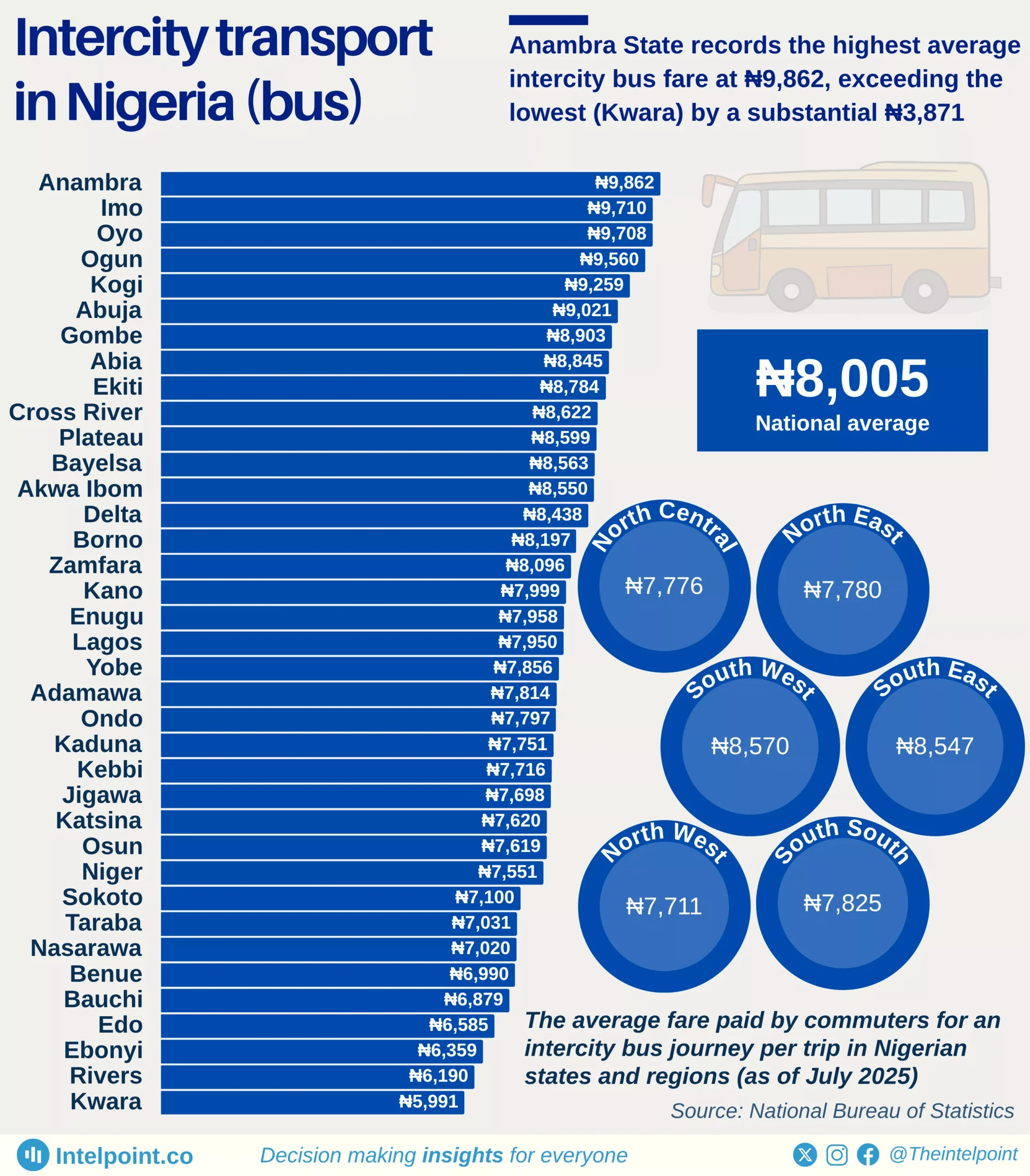
Anambra State records the highest average intercity bus fare at ₦9,862, exceeding the lowest (Kwara) by a substantial ₦3,871
  • Anambra has the highest intercity transport fare at ₦9,862, exceeding the national average by ₦1,857.
  • Kwara recorded the lowest fare at ₦5,991, a difference of nearly ₦3,900 from Anambra.
  • The national average fare for intercity bus travel stood at ₦8,005 as of July 2025.
  • Imo (₦9,710) and Oyo (₦9,708) followed closely behind Anambra, rounding out the top three highest-fare states.
  • The South West (₦8,570) and South East (₦8,547) were the most expensive regions for intercity bus travel.

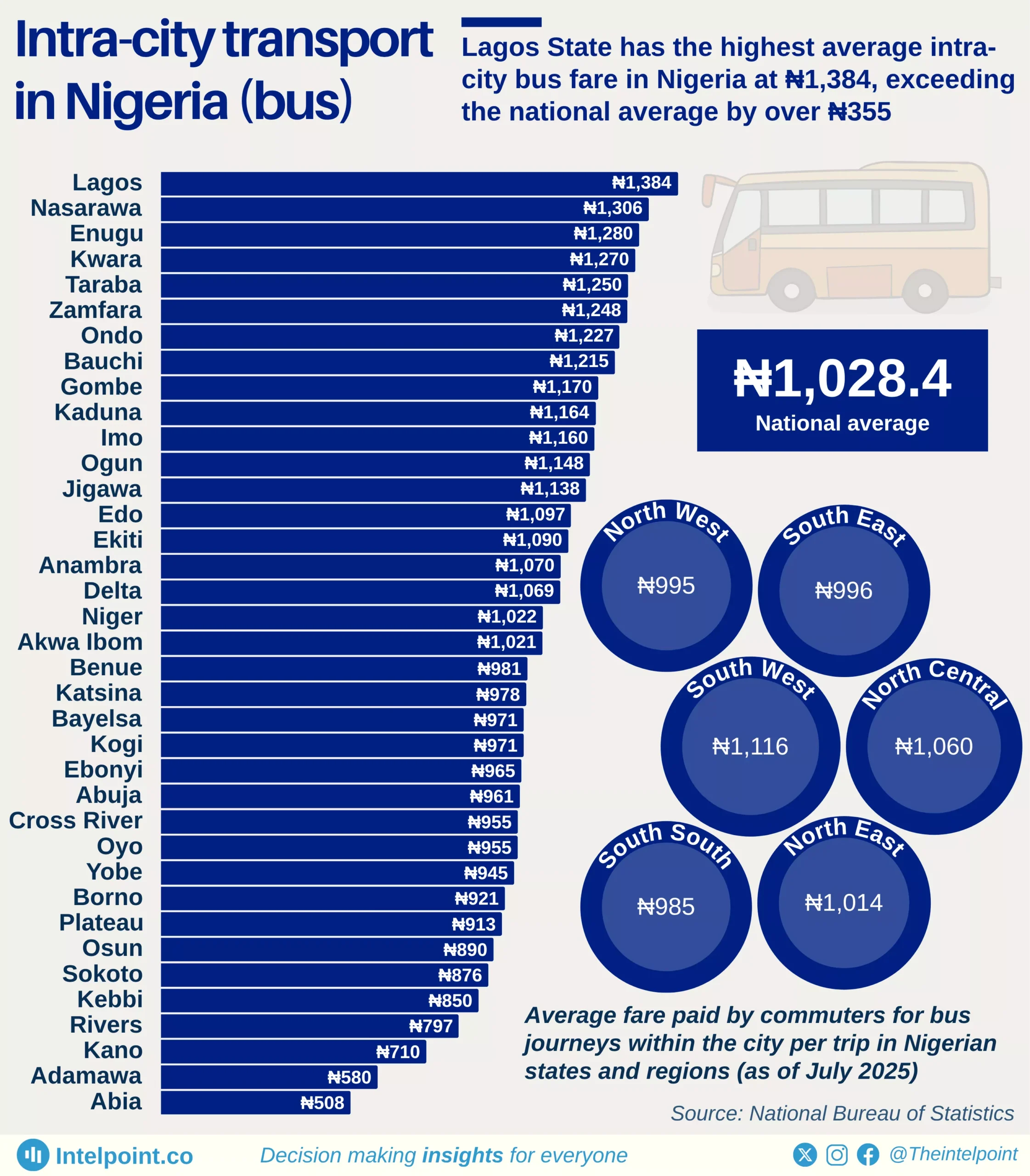
Lagos State has the highest average intra-city bus fare in Nigeria at ₦1,384, exceeding the national average by over ₦355
  • Lagos State tops the list with the highest intra-city bus fare at ₦1,384, exceeding the national average by ₦355.
  • Abia State recorded the lowest average fare at ₦508, showing a stark difference of ₦876 between the highest and lowest states.
  • The national average fare for a bus trip within Nigerian cities stood at ₦1,028.40 as of July 2025.
  • Nasarawa (₦1,306) and Enugu (₦1,280) followed closely behind Lagos State, rounding out the top three highest fares.
  • The South West had the highest regional average fare (₦1,116), while the South South (₦985) and North West (₦995) had the lowest.
  • States like Taraba (₦1,250) and Zamfara (₦1,248) also featured in the top six, showing that high fares are not limited to Southern urban centres.
 

POPULAR TOPICS
SIGN UP TO OUR NEWSLETTER
Get periodic updates about the African startup space, access to our reports, among others.
Subscribe Here
Subscription Form

A product of Techpoint Africa. All rights reserved